

Bitcoin’s ETF era has changed not only who buys the asset but why—and what that shift enables. The old market structure, ruled by illiquid exchanges and sentiment whiplash, has been replaced by an ecosystem where deep institutional vehicles quietly absorb supply from holders who have spent a decade waiting for dignified exits. This transition is less explosive than past cycles, but more consequential: it suggests a market moving from speculative crescendos to a methodical, almost corporate, redistribution of wealth.
The Architecture of Absorption
U.S. Bitcoin ETFs now custody over 1.33 million BTC, a figure that would have been unthinkable even five years ago. That accumulation happened not through mania but through daily, regulated flows—an orderly river of capital that gives large holders a path to liquidity without detonating price.
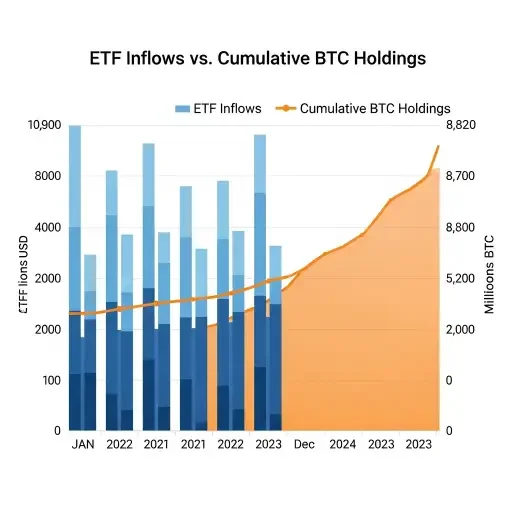
The flows themselves tell the story. BlackRock’s IBIT grew at a pace analysts described as historic, while legacy vehicles like GBTC shed billions during their conversion window. In older market cycles, such capital rotations would have left the chart looking like an EKG. In 2024–2025, the market barely flinched. Price absorbed. Volatility narrowed. Liquidity deepened.
That stability is the tell: someone is meeting the selling pressure.
The Quiet Exodus of the Old Guard
Blockchain analytics detected hundreds of thousands of coins moving from long-dormant wallets between late 2024 and 2025—coins untouched since the early days of GPU mining, forum trades, and lost-password folklore. Some of those holders have finally returned to the market with a methodical patience only liquidity can buy.
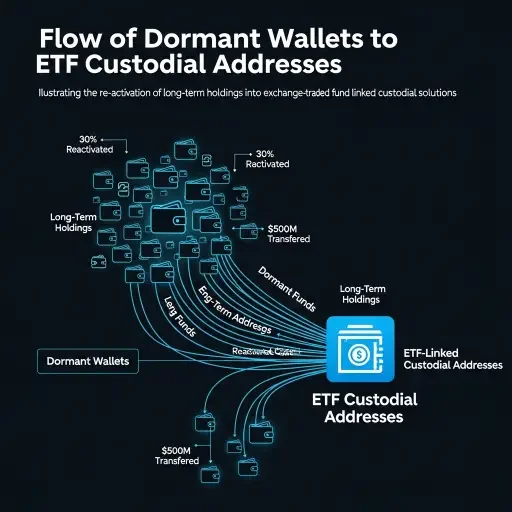
One example, disclosed quietly in industry circles: an early trader who built a fortune across Tradehill and Mt. Gox liquidated 11,000 BTC on Kraken in late 2025. This once-unthinkable sell-off—an eight-figure event—barely nudged the market. Thirteen years ago, such a move would have started a wildfire. Today, it sinks below the surface, absorbed by the ocean of ETF demand.
Bitcoin’s structure has mutated. Distribution is no longer panic. It is process.
Price Without Euphoria
Bitcoin’s journey across 2024–2025 was marked by new highs, pullbacks, and several quiet periods where price hovered above former ceilings without narrative fireworks. March 2024’s climb toward $73,000 gave way to a slower ascent beyond $100,000, culminating in fresh intraday highs scattered across 2025. And yet, these numbers now behave differently.
Volatility, the archetypal heartbeat of crypto, has cooled. Price responds with corporate politeness. The market has matured—or ossified—depending on the observer. The feedback loop of early adoption (innovation → speculation → bubble → crash → adoption) now looks more like the trajectory of gold after its ETF era: steep ascent, plateau, periodic pulses.
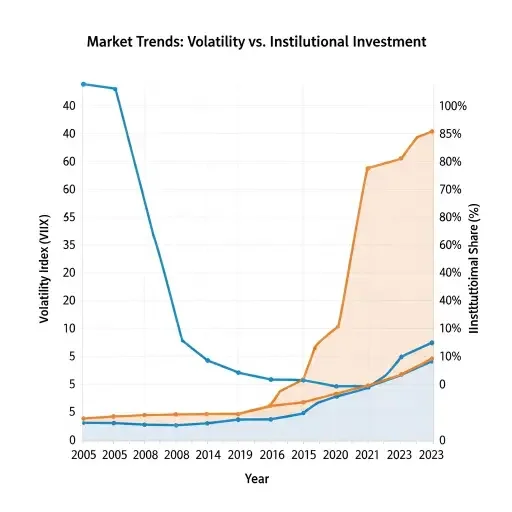
This isn’t stagnation. It’s normalization.
Ripple, RLUSD, and the Parallel Infrastructure
While Bitcoin settles into its identity as a macro asset, another transformation unfolds in parallel: the maturation of blockchain-based settlement rails that do not require Bitcoin at all.
Ripple’s rollout of RLUSD in December 2024 marked the beginning of this shift. Designed as an institutionally compliant stablecoin, it gained rapid traction through 2025—accelerated sharply by Ripple’s acquisition of GTreasury, the corporate treasury platform serving traditional institutions. The symbolism was unmistakable: a blockchain company didn’t just integrate with traditional finance; it absorbed part of its operational core.
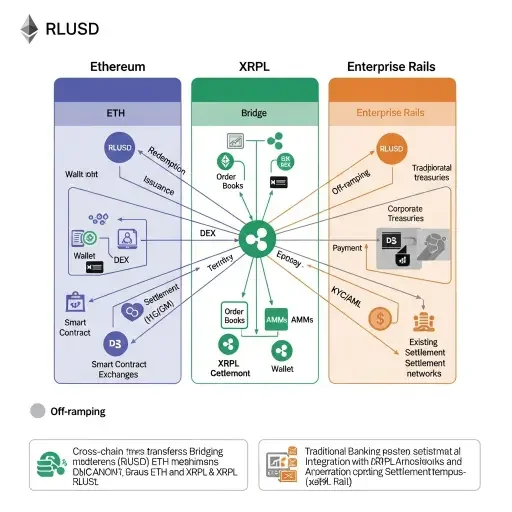
RLUSD, in other words, became plumbing.
XRP itself reminded the market of its latent volatility, climbing into the mid-$3 range by mid-2025—its strongest stretch in years. But the larger narrative wasn’t speculative. It was infrastructural: settlement rails no longer orbit Bitcoin’s gravitational center.
In practice, this means the future of blockchain utility may grow in arenas where Bitcoin’s role is symbolic rather than functional.
The Plateau Hypothesis
If Bitcoin’s new role resembles digital gold, its price behavior may increasingly mimic gold’s path after its own institutionalization. Gold surged post-ETF launch in the mid-2000s, then settled into a decade-long plateau once institutional allocations normalized.
Bitcoin now exhibits similar symptoms:
- Deeper liquidity that allows massive exits without outsized price impact
- Lower volatility that tempers speculative blowouts
- Predictable rebalancing flows from institutions holding 2–5% allocations
- Incremental adoption instead of reflexive mania

It’s not collapse—it’s compression.
Growth slows when an asset becomes part of the financial scaffolding. The wild west becomes a zoning district. And investors accustomed to exponential returns must confront an asset whose future gains may be steadier, narrower, and more influenced by macro conditions than crypto lore.
The Wealth Transfer Question
The philosophical question—the one people avoid because it complicates investment narratives—is simple: Who is selling to whom?
The data suggests:
- Early adopters, custodians of the mythic “diamond hands,” are distributing.
- ETFs and institutions are accumulating.
- Retail, through passive vehicles, stands between them as liquidity.
The transfer itself is not malicious. It’s structural. It’s how markets evolve when early risk-takers meet late-stage capital.

But the asymmetry remains: one group exits at scale; another enters with calibrated expectations; the third—retail—absorbs the difference, often without recognizing its role.
Bitcoin’s ETF era is a triumph of access and legitimacy. It may also be the largest, tidiest exit ramp ever built for the asset’s oldest participants.
The Recursive Summary
Bitcoin’s ETF-driven liquidity has transformed the market’s inner physics. Early holders now distribute into institutional demand that would have been absent a decade ago, while stablecoins and treasury integrations build a crypto infrastructure increasingly independent of Bitcoin itself. The result is a market that looks less like a frontier and more like a ledger: stable, deep, and slow to move. The silent handoff underway is both a maturation and a migration—a shift from insurgency to incumbency. For investors, the principle is simple: understand which side of that transfer you occupy.
Tags
Sources
ETF flow data from public trackers, institutional disclosures, blockchain analytics, and stablecoin market reports.